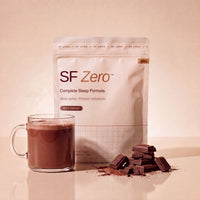
An investigation by SF Zero

Why no melatonin ?

Eight facts about the most popular sleep aid in America. The medical authority on sleep recommends against it. Eighty-eight percent of bottles tested were mislabeled. Children swallow melatonin more often than any other substance reported to poison control. No marketing. Just what the research says.

In this report
01 It's a hormone, not a vitamin
02 The medical authority recommends against it
03 It barely works
04 The label isn't the truth
05 The industry is warning you itself
06 Children are getting hurt
07 Everywhere else, it's prescription-only
08 New research raises serious questions

Eight facts. One conclusion. Whatever you do with them is up to you.

This page exists because we built a sleep brand around a single decision. No melatonin. We owe anyone who lands here the full reason why. Not a tagline. Not a bullet point on the back of a bag. The actual sources, the actual studies, the actual quotes.

We're not anti-supplement. We're against this one supplement, for reasons that each stand on their own. You can stop reading at any section. If by section three you've decided you'd rather keep taking melatonin, that's your call. We just want it to be an informed one.

01

It's a hormone. Not a vitamin.

You know melatonin as a supplement. Something you grab off the shelf next to the vitamins. But it isn't a vitamin. It is a hormone. And those two things are not the same.

A vitamin is a building block. Your body needs vitamin C, magnesium, fiber, and if you don't get enough through food, you can top it up with a supplement. Easy. Mostly harmless. You can't really overdose on vitamin C.

A hormone is different. It's a signal. Your body makes tiny amounts and sends them through your system to control big things. Sleep. Growth. Reproduction. Mood. They work in microscopic doses. Drop in more than your body asks for, and you don't get more of the effect. You get a different effect entirely.

Your brain makes about 0.3 milligrams of melatonin a night. The gummy on the shelf contains 10 milligrams. That is more than thirty times what your body would have made on its own.

Hormone What it controls
Testosterone Growth, muscle
Estrogen Reproduction
Cortisol Stress, energy
Insulin Blood sugar
Thyroid hormone Metabolism
Melatonin Sleep cycle

You wouldn't take thirty times the testosterone you naturally produce without a doctor's involvement. But for melatonin, somehow, you would.

Source: Harvard Medical School + NIH/JAMA, 2022
02

We suggest that clinicians not use melatonin as a treatment for sleep onset or sleep maintenance insomnia in adults.

American Academy of Sleep Medicine
Clinical Practice Guideline · 2017 · Still in effect today

Who are they? The American Academy of Sleep Medicine is the group that decides what counts as a real sleep clinic in the United States. They write the rules every sleep doctor follows. If you ever got referred to a sleep specialist, the guidance they used to treat you came from this organisation.

In 2017, after going through every study they could find, they told their own doctors to stop recommending melatonin to patients with chronic insomnia. Not the dose. Not the brand. The whole thing.

That guidance has been on the books for almost a decade. Almost no one selling melatonin on a shelf will mention it.

Source: AASM Clinical Practice Guideline, 2017

03

It barely works.

Melatonin has been studied a lot. Thousands of people, decades of trials. So does it actually help you sleep?

Barely. The most cited research found that melatonin gets you to sleep just 3.9 minutes faster than a sugar pill. Three minutes and fifty-four seconds. Less than one percent of a night. Other studies found a few more minutes. None of them found enough to call it real.

Doctors who study sleep say a sleep aid needs to add at least 15 to 20 minutes before it counts as actually helping. Melatonin does not get close. That is why the American Academy of Sleep Medicine, the group that writes the rules for every sleep clinic in the country, told doctors to stop recommending it for chronic insomnia.

The few minutes you do get are not the kind you think they are. Melatonin shifts when your body wants to sleep. That works for jet lag, or for shift work. It does not knock you out. It does not keep you asleep. The reason you feel something when you take it is mostly your body dealing with a hormone dose ten to thirty times higher than it would have made on its own. That is the grogginess. That is the strange dreams.

Add it up. You take a hormone every night, in a dose your body never makes on its own, for a benefit you wouldn't even notice. That is the deal melatonin offers.

What melatonin adds to your night
Without melatonin 8 h
With melatonin 8h 4min
+3.9 min
Source: AASM + meta-analyses cited in the 2017 guideline
SF-zero x jama research

22 of 25 bottles tested contained the wrong dose

04

The label isn't the truth.

In 2023, Harvard researchers tested 25 melatonin gummies sold in regular US stores. They wanted to know one simple thing: does the bottle contain what the label says? For most products, the answer was no.

Only 3 of the 25 bottles actually contained the dose printed on their label. The other 22 were off, sometimes by a lot. A few had less melatonin than promised. Most had more. The worst one contained nearly 4 times the dose on the label. So if you reach for what you think is a 5mg gummy before bed, you might actually be flooding your body with 17mg of a hormone you can't even spell.

Then in the morning you wake up groggy. Foggy. Like you didn't really sleep. You blame yourself, your stress, your phone, the wine you had with dinner. But the gummy you trusted contained more than three times what you signed up for, and your body is still trying to process it at 7am while you reach for coffee.

This is possible because the FDA does not test melatonin before it goes on sale. The company prints the label, and nobody checks. So when you buy a gummy, the dose printed on the bottle is a promise from the brand, not a verified fact.


88%

of bottles tested were mislabeled

up to 4×

the dose printed on the label

Source: JAMA, April 2023

05

WARNING

The industry is warning you itself.

In 2024, the Council for Responsible Nutrition adopted voluntary labeling guidelines for melatonin. That's the trade association that represents the supplement industry. The same companies that make and sell the gummies on your shelf. Their new guidelines tell consumers the product is for occasional and intermittent use only, and to consult a healthcare professional for long-term sleep issues.

Read that again. The supplement industry's own trade body is now recommending that melatonin packaging include warning labels. Companies that sell melatonin asked themselves to print disclaimers on the bottles. That is what an industry does when it sees a problem coming and is trying to get ahead of it.

Notice the word "occasional." Not "every night." Not "for as long as you need it." Occasional. The industry that sells you the gummy is quietly telling you not to take it the way most people are taking it. The label on your bottle may or may not actually carry this warning, because adoption is voluntary, not required. But the recommendation now exists, and somebody on the inside thought hard enough about the risks to write it.

Source: Council for Responsible Nutrition, 2024

06

Children are getting hurt.

In 2020, melatonin became the number one thing American kids were swallowing by accident. Not bleach. Not cough syrup. Not their parents' prescription pills. Melatonin gummies. Bright, sweet, sitting on the kitchen counter, indistinguishable from candy to a toddler who climbs.

+0%

More cases reported to poison control. 2012 to 2021.

0

Total reports across the decade.

#1

Most-swallowed substance by kids in 2020.

2 deaths

Both under age two. 4,000+ hospitalized.

Calls to poison control about kids and melatonin grew 530 percent between 2012 and 2021. Over a quarter of a million reports. More than 4,000 children ended up in the hospital. Two children died. Both were under the age of two.

The industry kept selling. Melatonin gummy sales nearly tripled in those same years, from $285 million to $821 million. Most of that growth came from the gummies that look exactly like the ones kids reach for at the candy aisle.

The CDC's response was an advisory: keep the bottles out of reach. That was it.

Cases reported to poison control
53K 30K 15K 0 2012 2021 8,340 52,983
Source: CDC MMWR, 2022 + 2024

07

Everywhere else, it's prescription-only.

In almost every other developed country, you can't just walk into a store and buy melatonin. You need to see a doctor first. In the UK, in Germany, in Australia, in Japan, melatonin is treated as what it is: a hormone, a medical substance, something a physician oversees. The United States is the exception. There, you can find it in the gummy aisle next to the vitamins. Children's versions. Adult versions. Bottles of 200.

Why is the US different? In 1994 a law called the Dietary Supplement Health and Education Act, or DSHEA, created a new category called "dietary supplement." Products in that category did not have to be tested by the FDA before being sold. Melatonin got pulled in under that umbrella, and it has stayed there ever since.

Other countries never passed a similar law. So in Berlin, London, Sydney, and Tokyo, melatonin is still what it has always been. A hormone. A prescription. Something a doctor signs off on.

If other countries with serious medical systems decided this was something only a doctor should hand you, that's worth knowing before you reach for the next bottle.

"Dietary supplements are not required to obtain FDA approval before they are marketed."

U.S. Dietary Supplement Health and Education Act, 1994

European Union
Prescription
United Kingdom
Prescription
Australia
Prescription
Japan
Prescription
New Zealand
Prescription
United States
Gummy aisle
Source: FDA / DSHEA, 1994

08

New research raises serious questions.

In November 2025, researchers from SUNY Downstate in Brooklyn presented one of the largest studies ever done on melatonin and the heart. They looked at the medical records of 130,828 adults with chronic insomnia. Half had been prescribed melatonin and taken it for at least a year. The other half had never been prescribed it. The two groups were matched on 40 different factors. Age. Gender. Existing conditions. Other medications. Forty variables, all controlled for, so that the only meaningful difference between the two groups was the melatonin.

Then they followed both groups for five years.

The melatonin users were 90% more likely to be diagnosed with heart failure. They were nearly three times more likely to be hospitalized for it. And across the whole group, they were twice as likely to die from any cause during the five-year window. 4.6% of melatonin users developed heart failure versus 2.7% of the people who didn't take it.

The findings were presented at the American Heart Association's Scientific Sessions in New Orleans, the biggest cardiovascular research event of the year. This is not a fringe study, nor a small one. It is the largest cohort ever examined on this specific question, and it suggests something the supplement industry has spent decades insisting wasn't true: that taking melatonin long-term might not be harmless.

+0%

Higher risk of heart failure among long-term users

~0×

Hospitalization rate compared to non-users

0×

Twice as likely to die from any cause

A note on this study: The findings are observational, not yet peer-reviewed, and show association rather than proven cause. More research is needed. We include it because the size, the methodology, and the direction line up with everything else on this page.

Source: AHA Scientific Sessions, November 2025
Eight facts. One expert.

I am a strong believer in avoiding taking exogenous melatonin.

Dr. Andrew Huberman
Stanford School of Medicine · Huberman Lab

His recommendation for sleep is not one ingredient. It's a combination. Three things you can take without worrying about what they do to your hormones.

Magnesium glycinate L-theanine Apigenin
Source: Huberman Lab Podcast, 2022
This is what we built

Exactly the right ingredients. And nothing else.

The average sleep supplement on the shelf contains between fifteen and twenty-five ingredients. Most of them don't need to be there. They're added because more sounds better, because a long label looks impressive, because filling space is cheaper than proving effect.

We took the opposite approach. If an ingredient didn't have multiple peer-reviewed human studies behind it, it didn't go in. Not animal trials. Not lab-only research. Not herbal extracts marketed on tradition. The bar was real science, real people, real doses, with results that have been replicated more than once.

Ten ingredients passed that bar. Four active ones, each clinically proven to do something specific for sleep. Six supporting ones that turn it into something you actually want to drink, a warm cacao you sip before bed. Every dose is on the label. Every batch is third-party tested. Nothing hides behind a proprietary blend.

And here's the thing about a high bar. A lot of ingredients you'll find in other sleep products didn't make it. Melatonin is the obvious one, but there are eight others we won't touch. The sleep aid currently on your nightstand almost certainly contains at least one of them. They're not as harmless as the label makes them look. The full list, and why each one didn't make our formula, is on the ingredient page.

Magnesium glycinate

200mg

USA

L-theanine

200mg

Japan

Apigenin

50mg

Egypt

Ashwagandha KSM-66

300mg

India

Natural cacao powder

4g

Peru

Melatonin

0mg

By design

Magnesium glycinate

Magnesium calms your nervous system and helps your muscles relax before bed. The problem with most magnesium supplements is that your body barely absorbs them, and they upset your stomach. Glycinate is the gentle, well-absorbed form. The one used in real sleep studies.

Why this dose

200mg is the level researchers use in clinical sleep trials. Enough to feel the calm, not so much that you wake up groggy.

L-theanine

L-theanine is a natural compound found in green tea. It creates the kind of calm you feel after a deep breath. Quiet mind, no drowsiness, no hangover. It's why people feel relaxed after green tea but not sleepy like with coffee.

Why this dose

200mg is the amount used in studies that measured how fast people fall asleep. Less than that, and you don't feel a thing.

Apigenin

Apigenin is the active part of chamomile. What makes chamomile tea relaxing. The catch: a normal cup barely contains any. We use the concentrated version. 50mg here equals what you'd get from 20+ cups of tea, without the bathroom trips.

Why this dose

50mg is the exact amount Andrew Huberman recommends in his nightly sleep stack.

Ashwagandha KSM-66

You know that moment when you snap awake at 3am with your heart racing? That's a stress hormone called cortisol spiking in the middle of the night. Ashwagandha lowers it. KSM-66 is the version with the most science behind it, over 40 human studies.

Why this dose

300mg is the standard amount used in studies that showed lower cortisol over 8 weeks.

Natural cacao powder

Real cacao, not the Dutch-processed kind. Most brands use alkalized cacao because it's smoother and cheaper. The problem: that processing destroys most of what makes cacao actually good for you. Ours stays raw, so the chocolate flavor is real and the cacao is doing real work.

Why it's here

Cacao is the heart of the ritual. It's also a natural source of magnesium and tryptophan. Small amounts, but real.

Melatonin

Melatonin is a hormone, not a vitamin and not a supplement. Your brain already makes it. Most sleep aids add 10 to 30 times more than your body produces naturally. New research links long-term use to a 90% higher risk of heart failure. So we left it out.

Why not

Your body already makes it. We don't need to add more.

1 OF 6
Replace the bottle

Better sleep. Without the hormones. Without the filler.

You read the research. You saw what doesn't belong in a sleep formula. This is what we built instead, and we didn't build it as a chalky pill. We built it as a hot cacao drink. A proper one. Rich, warm, and the kind of thing you actually look forward to at the end of the day.

Your FREE starter kit comes with a 30-serving bag of SF Zero, a milk frother to whip it up properly, an aluminum scoop for the exact dose, and free monthly delivery so you never run out. Everything you need to swap the bottle on your nightstand for the best part of your evening, starting tonight.

SFZ STARTERKIT 2
SF Zero Complete
SF Zero Complete
30 servings
$62$46.50
Your First Order Includes
  • Milk frother
    Milk frother
    Smooth, café-quality cacao at home
    $10FREE
  • Aluminum measuring scoop
    Aluminum measuring scoop
    For precise daily dosing
    $5FREE
  • Monthly delivery
    Monthly delivery
    Free shipping, every order
    $5FREE
  • Free gift, next order
    Free gift, next order
    A surprise dropped in your second box
    $20FREE
Total
$89,95$46.50
Start Tonight
  • Free Shipping
  • Cancel Anytime
  • 30-Day Guarantee